
The Startup Playbook
Shreyans Salecha
Jun 19, 2026
The story that broke Indian startup Twitter. Everyone has an opinion, but when friends who invest in public markets asked me what's going to happen, it made me think. Now, I could be terribly wrong about all of this, but it's one of the most exciting thought experiments.
Let's start with the deal. 500mn primary, 400mn secondary. There are two extremely important things from this:
Now, there's a lot of speculation about how WhatsApp (Meta) & Cred will or could collaborate. I don't think that's going to happen (I think the only thing common between them is the sheer number of things that can be argued as useless for their core purpose). I think it's purely a financial investment (and I don't think Meta really cares about the return) - that was the only way they could get Kunal to leave Cred. He wants the company to continue to operate from a place of strength. Lots of people have written about Miten being a capable CEO. I'm sure the same is true for their larger leadership team.
So yes, I think both will go their separate ways from this, although it does open doors for a much broader talent and capital flow. I'll share my views on both one by one.
Ever since it started, Cred was probably the most talked about startup. However, a lot of people were silently or vocally bearish about them. And the limelight shifted to startups that went public, quick commerce and services, everything related to AI (and for all good and valid reasons). Now, Cred is back in the news, and despite the founder leaving, the sentiment around them could turn positive. Let's break down the obvious and the non-obvious.
Everyone knows how Cred has the most valuable Indians. Over the years, they've done everything to keep them on their app. And I think we've seen a fraction of what they can do. It's a stupid thing to say, but they probably started paying attention to business only recently - before that, it was just building lock-in. From what I could find online, most of their revenue comes from lending, which appears to be small-ticket, short-term loans. I don't buy that the marketplace or any of the other things are valuable from a revenue perspective (they are from an engagement perspective).
But think about it - Cred has only captured short-term loans for the most creditworthy Indians (I don't know if most even need it). What about everything else? Their investments, their insurance, their expenses, their wealth, their business, even long-term credit. Do you realise how insignificant what they currently do is, in the larger scheme of things? Do you think they don't see it? I'm sure they want everything, and they'll have to win it from lots of different players.
So here's my completely uninformed guess - Cred wants to be the full-service bank for the wealthy. I have no idea whether they'll get the regulatory licences or not (probably the biggest bottleneck), but I'm willing to wager that that's exactly what they're working towards. This might sound like having to do a lot of things, but you never know with momentum. They want to be the first tech-led bank (like the financial services bank) in India. While I'm making speculations, I might as well think out loud about how they're going to do it.
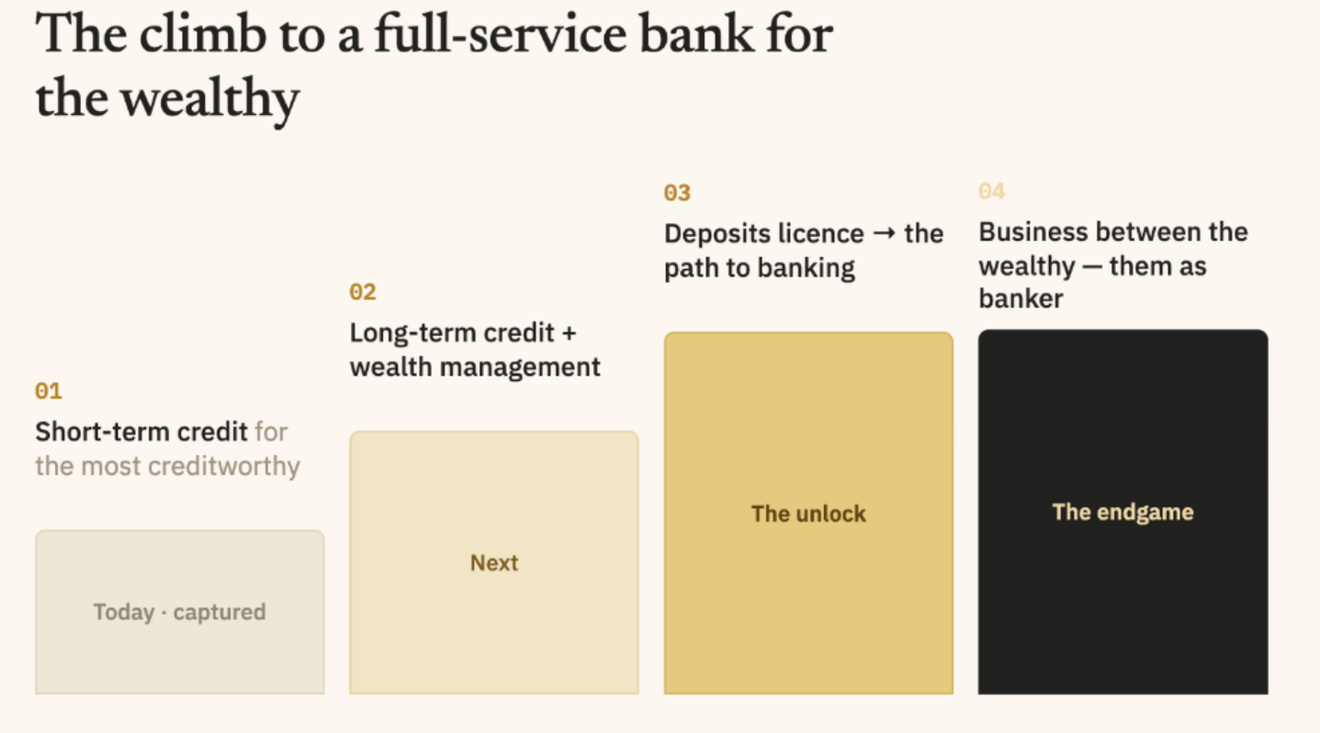
I think their next two priorities will be - long-term credit and wealth management. Long-term credit is the logical next step. Here, it's also important to understand that I think Cred targets the new-money-rich in India, not the old-money-rich, and they want a totally different user experience. This group is maturing and will mature into asset buyers, and they'll control more and more assets with time. Who knows, someone somewhere will start building the Cred for Gen Alpha or whatever the new ones are called. So, Cred becomes the lender of choice for them.
At the same time, they want to advise these people on the wealth they're building. It's worth noting that most of them probably don't have the kind of wealth that the old-money has, but they're earning more and more, and they want to invest it. I don't think Cred wants to become a broker (although they might have to, to service demand). I think they want control and influence over assets. Today, they offer fixed deposits, gold, and silver. I think we'll see portfolio management and alternative investment services fairly soon. Long-term credit is primarily used for real estate (where I'm sure they'll launch some operational services to have influence), so that completes practically all your assets. Also, don't forget that most of the new-India-rich will have all white money (black money rich; white money poor people don't get high credit scores) so it can all be managed completely digitally.
This leaves two missing pieces. The first, and the most important one, is deposits. If Cred gets a licence for deposits, I think that opens up the path to a banking licence (yeah, I know it's not that straightforward, but getting a deposit licence is extremely hard as is). The other sign will be them receiving another large investment from private equity or an important legacy financial institution. I think they start work on this once they've made meaningful progress on wealth and long-term loans. The final piece is getting people to do financial transactions with each other, and no, I don't mean UPI. I mean business transactions. Cred users are likely to be decision-makers in enough places to control how their respective organisations deal with money. This one is perhaps the true long-shot of everything Cred can do, but this is where the real value sits. Honestly, it's difficult for me to think through the specifics of how it could work out, but I'm sure they'll find ways to get the richest people to do business with each other, and them being their bankers.
The most telling thing about Cred goes back to their origins - the people they went after. Throughout all these years, they've made no effort to go into a lower economic strata, and I think they have no intention to. They've got a large enough group of people from their target market; they've spent bucketloads of money to make them stick around, so now, they start to monetise. That ends my note on Cred. I must be clear that I don't know anyone at Cred, so everything I'm saying is a pure outsider perspective, and could be completely wrong. Now, let's get to WhatsApp, and along with it, Kunal Shah. Why Kunal Shah? Apart from the insiders, I don't think anybody knew, and I don't think anybody can guess. But of course, I have a theory.
WhatsApp today faces an identity crisis. It's probably the most successful consumer app anywhere in the world - it's used in more ways than anyone can imagine, and at the same time, it frustrates all kinds of users in different ways. We don't know if it's a personal app or a business app. If you think it's a personal communications app, it's probably too bloated for that. Everything apart from text/voice/video is probably unnecessary or forced. I get more promotional messages from businesses v/s messages from my friends. I've seen enough people make this complaint.
If you think it's a business app, it doesn't do enough - you send out what promotional and update messages to people who've interacted with something you sell. Of course, there's a whole host of individual workers for whom communications is business, so they use it for that.
WhatsApp is a messaging app; it's also a CRM tool, it's also a promotional channel, it's also your community, and of course, you can make payments through it (but nobody does really). Despite all this, business in India practically lives on WhatsApp. We've invested in or talked to enough companies and founders now to say that WhatsApp is truly the backbone of India's small businesses.
That's why Kunal Shah. The fundamental challenge that lies ahead of him is to create clarity about what WhatsApp is, about what it needs to do, and for whom. That's a large enough challenge for someone who's seen as one of the greatest thinkers in the Indian startup world. Now, take a moment to think about the scale of the challenge - whichever way you choose to go, you're going to have to go away from something that's equally important. If you choose personal, then the business side (which sits very neatly into Meta's larger business ecosystem) is at risk. If you choose business, then you risk the disruption of a new personal chat app. So, the unique challenge is to find a way that satisfies both. Another interesting aspect is that most of WhatsApp's user base has a very different economic background to that of Cred's user base. Economic situation is not everything, but it significantly influences how anyone behaves. So now, you have to build a personal communications app that people don't get irritated by. And, the same app also has to offer more substance to those who use it on the business side, and truly leverage the power of network effects. That's one hell of a problem statement, and at that scale, unimaginably difficult.
However, I think this identity crisis is not restricted to WhatsApp. It's something that goes deep into Meta. Think about it - they built the world's largest social platform but then they had to find a way to monetise it, so they started selling their audience to brands. Fundamentally, all their revenue is ads/spends from businesses. So now, people are tired of it. This probably means Kunal's role is unlikely to be restricted to WhatsApp - he will have to (and I'm sure he himself wants to) contribute to Meta's larger ecosystem - how their different apps and products fit into different personal and professional use cases, because their products are indispensable and also inseparable.
Now, let me get to the biggest dynamic in this entire speculation, which is the technology of today & the future - AI. All the big players have broadly chosen their paths and the part of the stack they want to dominate. From Meta's perspective, their competitors are OpenAI and Anthropic. They're fighting their own battles concerning consumer & enterprise, but people are using their models; people see them as leaders in AI advancement. The only thing we've heard about Meta & AI is open-source, open-source. There too, Chinese models probably get more attention for either performing well enough or being significantly cheaper. Where is Meta in that conversation? As purely a user of AI, they're just irrelevant besides asking an infrequent question to Meta AI on WhatsApp. They are losing; they are losing big time. This is despite all the capital that they've allocated and committed to allocate. This is despite being the largest consumer-tech company in the world and integrating Meta AI into all their products. They will have to spend the money, but what part of the value are they going to go after?
You need to win back consumers; you need to win back their attention, specifically with regards to using AI. Again, maybe that's why Kunal Shah. First, we must understand that whatever we see of AI, every single thing we see of AI today is a tip of the iceberg - the state of the art today will look like technology hacked together five years from now. We are just getting started.
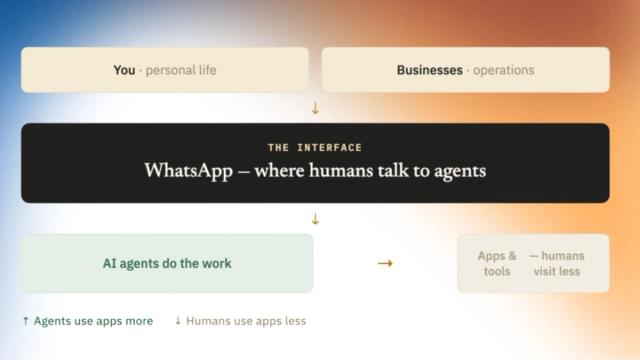
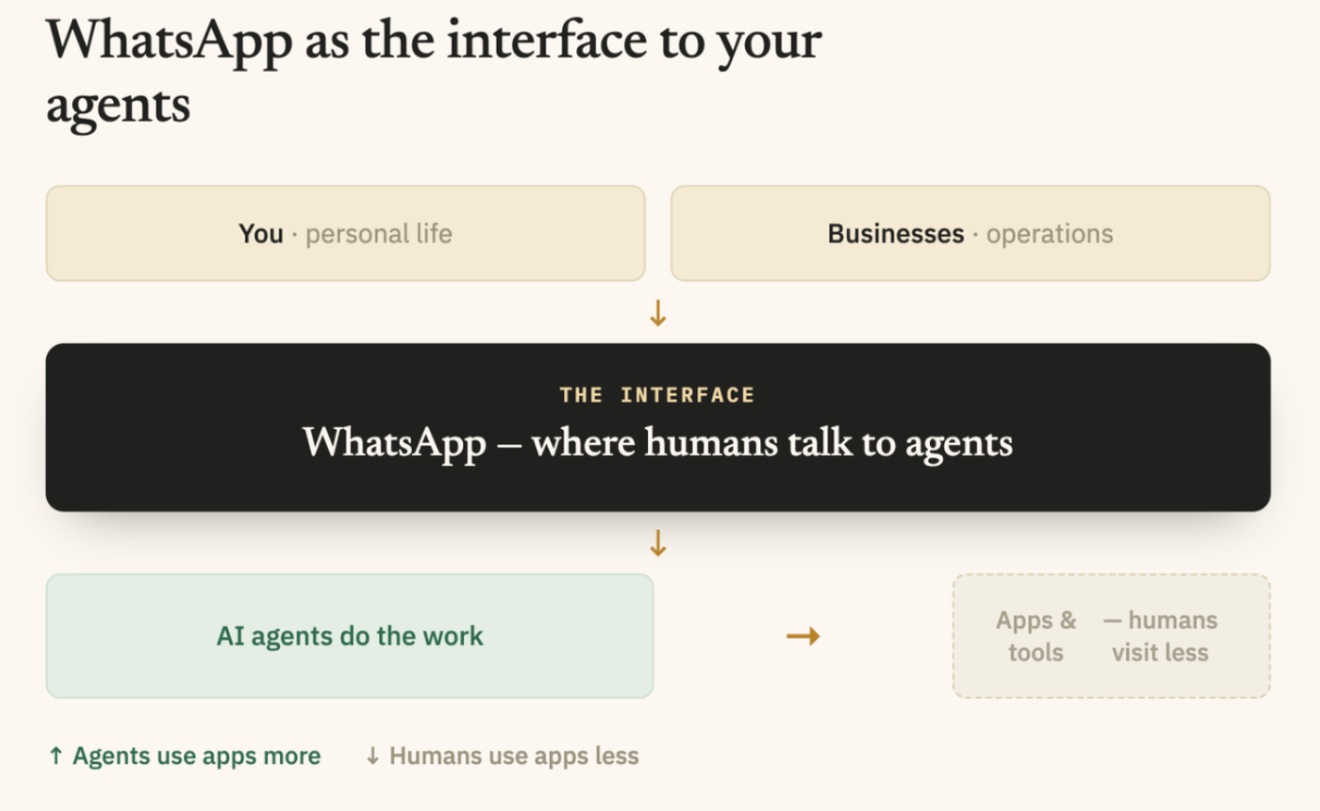
AI agents are doing a lot of things today, and they are going to do more and more things in the future. Now, there's a reasonably valid argument to be made that as AI agents do more and more of the work for people, users will no longer visit all the different interfaces (read software and tools). I'm sure the best founders have already realised that as AI uses their apps more, people are going to use their apps less. They've already started to model their products to win the attention of AI agents. But what does this mean on the consumer side? They'll still need an interface where they interact with AI agents. We get so much of our personal stuff done today through WhatsApp. Businesses get so much of their work done today through WhatsApp. So why can't WhatsApp be that interface where we talk to our agents? For business and personal use cases alike. Maybe that's what Zuck has in mind.
Here's my thesis on WhatsApp/Meta. I think we're going to see a lot of decluttering of products and use cases in their larger ecosystem. They're fighting so many battles on so many fronts, and they can't do everything everywhere because they've already tried that and seem to be losing in the long run. Also, please understand what a truly historical company Meta is, where they're doing so well and can still be judged so harshly, because we expect everything from them. They'll have to reduce the focus on specific products while increasing the scope of what they, as a company/ecosystem, can do. The same challenge of creating clarity while also making progress. And of course, we have an Indian who'll contribute to this.
Shreyans Salecha
Jun 19, 2026

Shreyans Salecha
Apr 21, 2026

Shreyans Salecha
Mar 13, 2026

Amani Chowdhry & Arjun Malhotra
Sep 10, 2026

Radika Agarwal
Aug 6, 2026
Amani Chowdhry
Jul 10, 2026
Stay Ahead of the Curve
Contact
Find the team member whose focus overlaps with what you’re building, or someone we both know who can introduce you.