India’s most attempted market is still unsolved
A few weeks ago, I put out a tweet asking which startups have done a good job selling to MSMEs in India. The result was… mostly crickets. And when people did start replying, the answers were very similar: Zoho, Tally, Vyapar, and Razorpay. This was expected. What was unexpected, though, is that my tweet got 12 likes with 7 saves. The ecosystem is forever curious about how to monetize this audience. Even internally, within our team huddles every few months, we find an idea that fascinates, but we're rarely able to pull the trigger on investing in the company.
India has ~80M MSMEs registered on the Udyam portal and yet, barely a handful of companies› have cracked selling to them. Not for lack of trying; this is one of the most attempted, most obvious markets in India, and yet startups have either failed to scale or to sustain that flight (that may be a pun). This newsletter is an attempt to break down what works and why.
India is not a DIY market; it's a DIForMe (do-it-for-me) market. SaaS as a category was built for economies where labor is expensive enough that automating a task is cheaper than paying someone to do it. That has never been India. When you can get an engineering grad/ CA for 30k a month, it’s hard to justify ~$2000 in annual payouts to ‘save time’ when you still need a person to operate that software. “I’ll just hire someone to do it” has been the entire attitude toward software for the length of India's SME history, and as much as I hate to agree, it’s “practical”.
1. Compliance
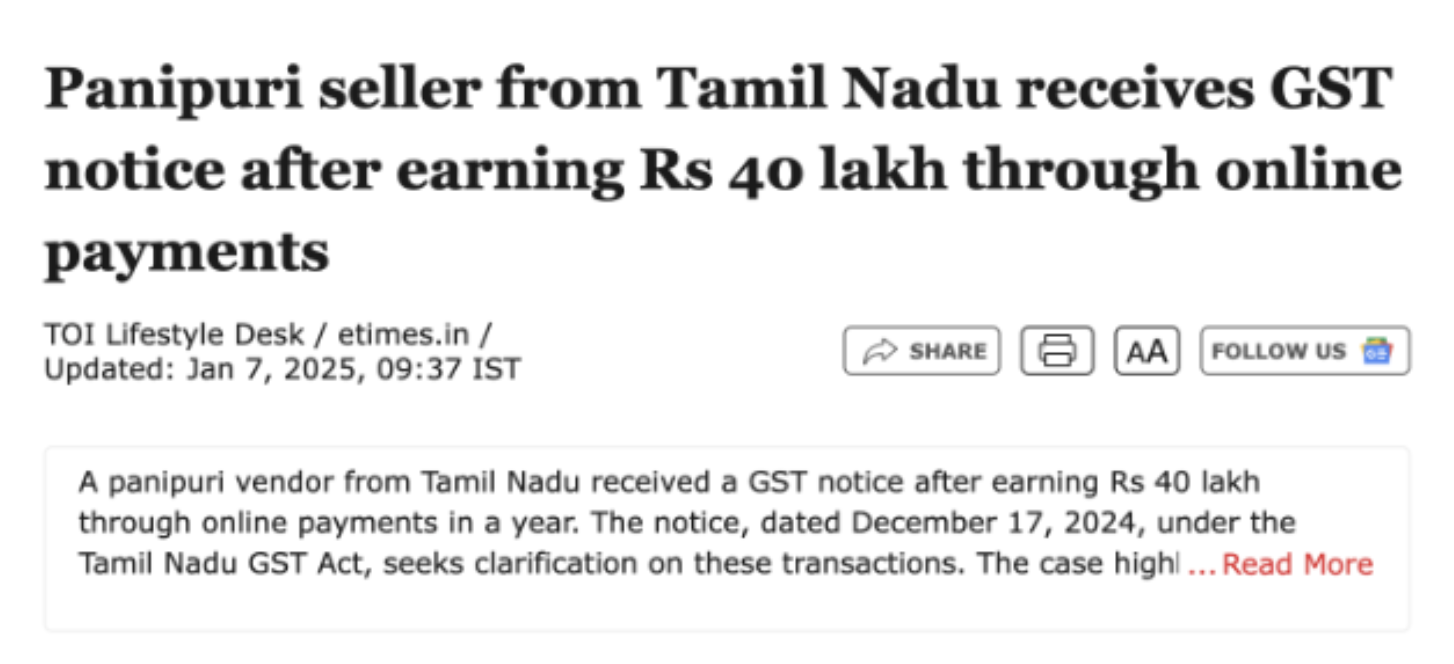
As the world of Twitter rightly mentioned, the first wave of startups successful in this ordeal is the Zoho, Tallys, Vyapars, and Petpoojas of the Indian ecosystem. All of them handle billing, accounting, and GST in some shape and manner. PetPooja arguably does a lil bit more. They sell because if a gol gappe seller can get a GST notice, a manufacturer in Jaipur definitely can, and it’s better just to do it before the govt puts a danda and maybe tells you to stop your dhanda. E-invoicing thresholds have been sliding down - from a ₹10 crore mandate to ₹5 crore, with more policy chatter about pulling it to ₹2 crore. What this essentially means is that every year, without a single sales call, more SMEs wake up newly required to buy this software. Even here, the practicality is equipping the in-house accountant with software (in some cases pirated) so you don't have to pay a CA firm.
2. Revenue
My favourite example of a startup that has been able to work with MSMEs actually comes from Good’s portfolio- it’s Meesho (yeah, I’m tooting my own horn). Meesho put suppliers (manufacturers) in front of buyers (resellers) who were already looking for them. Eventually, they gave MSMEs a way to unlock online demand without understanding how to set up a website, perf marketing, and whatever other jazz. IndiaMART is another great example.
What I can see for Meesho that worked was the clear-cut proposition- sign up to our platform, and we’ll bring you demand. IndiaMART charged a menial subscription fee; Meesho skipped that too. Nothing about their model required the MSME owner to look at a dashboard and figure out if the investment (time or money) is worth it. They only had to see the money hit the bank, and let’s be honest, we all love a deposited notification on our screens.
3. Logistics + Procurement
Very sparingly- Shiprocket, Delhivery, Porter, and a couple of other logistics startups have also been able to capture their audience by delivering the same service these businesses have used for decades but making it more efficient. It is also worth noting that these startups did not aim to service SMEs, but SMEs started adopting because the traditional fragmented solutions weren’t good enough. The next function that we’re seeing momentum in is procurement, and we’re seeing two waves.
Consumerisation of B2B: Navo is another great example. They’re doing video-based wholesale fashion sourcing. Almost like a reimagined teleshopping but for businesses. At-home discovery, video-led buying and a trust layer that didn't used to exist. Business buying is starting to look and feel like consumer buying, which is a genuinely underrated shift.
B2B Quick commerce: The wave started with the likes of Ofbusiness making on-demand delivery of construction materials possible. They later stopped serving MSMEs, but this has led to a second wave of quick commerce startups. We’ve seen a few companies attempt this with construction materials like Material Depot and Buildbee. In fact, Digital Labour Chowk & Dihadi are even making labour on demand.
Companies here are aiming to convert demand faster, offer larger catalogs, help SMEs lose less time to a broken supply chain, and make money as a byproduct.
What didn't work: rebranding the SME
Then there's the version of this that looked right and wasn't: OYO and 1K Kirana. Both tried to take an unbranded SME (a budget hotel, a kirana store) and turn it into a branded, standardised node with better demand and a CRM behind it.
The idea sounded great in theory, but practically, these brands owned the promise of quality but not the actual service delivery. The hotel was still run by the same owner and the same staff who ran it before OYO showed up. The kirana was still stocked and staffed the same way after 1K Kirana touched it. The company absorbed the cost of standardizing the experience- signage, software, sourcing- without gaining control over the one thing that actually determines whether the customer has a good experience. You can't sell a promise you don't control the fulfillment of, at scale, indefinitely. OYO eventually pivoted to being full stack on supply with their townhouses while 1K kirana, well, shut down.
Why it’s worth trying to make it work
MSMEs contribute ~31% of India’s GDP or over $1T. There's a structural gap in almost every Indian SME. The owner holds all the judgment — pricing instinct, vendor relationships, what "good enough" looks like, what's worth escalating. The supervisor can execute, but doesn't have the owner's judgment and was never going to get it through osmosis alone. There's no middle management layer translating one into the other, because a business this size was never going to pay for one. Technology that can plausibly sit in that gap. Large enterprises solve this with CRM, but how do you sell software the owner is supposed to use when he doesn’t even use email? AI can be the translation. The missing middle between the smartness of software and the digital literacy of the owner.
What AI makes possible
Every prior generation of SME software needed a dashboard, an English-language UI, formal training, clean data entry, and process discipline the business never had- a lot of DIY asked of a DIForMe market. With AI, the software can live inside WhatsApp, take voice input in Hindi, Tamil, Marathi & can have a conversation- like talking to an assistant. PayNearby's MSME Digital Index (2024, 10,000+ MSMEs surveyed) found that 70% of owners prefer smartphones for both personal and business activities and almost 97% of the businesses use WA vs-
- Formal accounting software: ~25-29%
- CRM software: ~14-17%
- POS software: ~17-20%
India already has over 100 million weekly active users of ChatGPT. The habit exists. A PwC report pulled three years of annual reports from 25 largest large-cap manufacturers searched for mentions of "AI" or "agentic AI.” Total Count: 963. The same search across the 25 largest listed SME manufacturers in India turned up 29 mentions.
My theory - The desi Palantir playbook
SMEs will not adopt a tool, and even if they do, they won't ride the learning curve till someone literally hand-holds them through it. And maybe, the answer is some desi version of Palantir. Once the SME signs up, an engineer camps out in their factory to understand the workflows. Within two to three days, they implement the product with the users. Nobody has to be smart enough to figure out the product. They only have to use it, in a familiar interface like WA, like an addition to their team, instead of a tool. Every customer who signs up gives you a usable block that you can use on another customer. A manufacturing workflow for clothes may be very similar to a manufacturing workflow for shoes- sourcing raw material, sorting it, assigning it to the right departments, moving through the assembly line, and finally packaging it for delivery.
The catch
I have to fully acknowledge that low ARPU contracts can't fund expensive onboarding, and that's the catch with this idea. But just maybe, with AI, the cost of customisation at n=1 is much lower such that it may just be possible. And well, the moat- deep embedding in workflows and high barriers of entry.
The opportunity was never to rebuild the Indian SME. It's to let it operate with leverage it never had access to before and for the first time without asking it to “learn technology,” and then we hope they pay.