
The experience economy is now the proof-of-experience economy
A few months ago, an Instagram page went viral for selling fake concert stories. You paid a small fee and got sent footage to post as your own. If you’d like, they can even do a tagged story so it looked like someone else had filmed you there, and you could repost it.
The same page later branched out: a coffee cup sliding across a Starbucks counter with your name on it, a cashier handing you a bag, or a mall on a weekend afternoon. The page capitalised on providing anonymous proofs that you’d been living a life worth an Instagram story.
It’s strange to me that we’ve come to a point where we don’t have to buy a ticket to a concert, heck - not even a memory of it. We can now just buy the proof that we’re the kind of people who go to concerts, and the concert itself is apparently the skippable part (!?)
I didn’t think experience itself would be the first thing to become optional in an experience economy, and the evidence of it would become the whole product, but that’s where we’re at. What has started with people clicking photos of their food in a café aesthetically has come to a whole new lens on how we consume experiences. I think it’s worth pausing and studying this shift, which is what I aim to do here.
What a signal was, and what it is now
A status signal by definition is something that should be hard to fake and replicate - as it should be accessible to only a few. The difficulty of procurement in itself is the message.
For example, a Chanel bag said something because it cost money you presumably had and most people didn’t. For most of modern history the status bars we cleared were about having something. You owned the house, the car, the coat with the name stitched loud across the front. These tangible things were slow to get, expensive to keep, easy to read from across a room.
Having soon stopped being hard to fake. The superfakes got super good - good enough that the resellers can’t always tell, and good enough that the bag on the arm tells you nothing about the bank account behind it. Once anything you own can be copied perfectly, owning it stops proving anything. Owning has even started to read as flashy, a little “try-hard”, especially for GenZ and the small strata of capitalism-wary-environment-loving groups.
So the flex moved from something you had to something you did. And it’s been a weird jump, because doing is so much more work than having, even though that was the whole appeal. Doing interesting and honestly slightly obscure things now read as tasteful. The flex soon stopped being the bag and became the trip, the marathon, the pottery class where you make a wobbly bowl and shoot it in good light. Experiences were supposed to be the better signal precisely because you couldn’t buy them off a shelf - you needed the time, the friends, the curiosity. More importantly, you needed the life, and that used to be harder to fake.
But everything gets counterfeited, and the counterfeiting is what kills it
I’ve come to believe every signal carries the instructions for its own death. The loud brands of course went first. Experiences were supposed to be safe from that as they were harder to copy, and for a while they were.
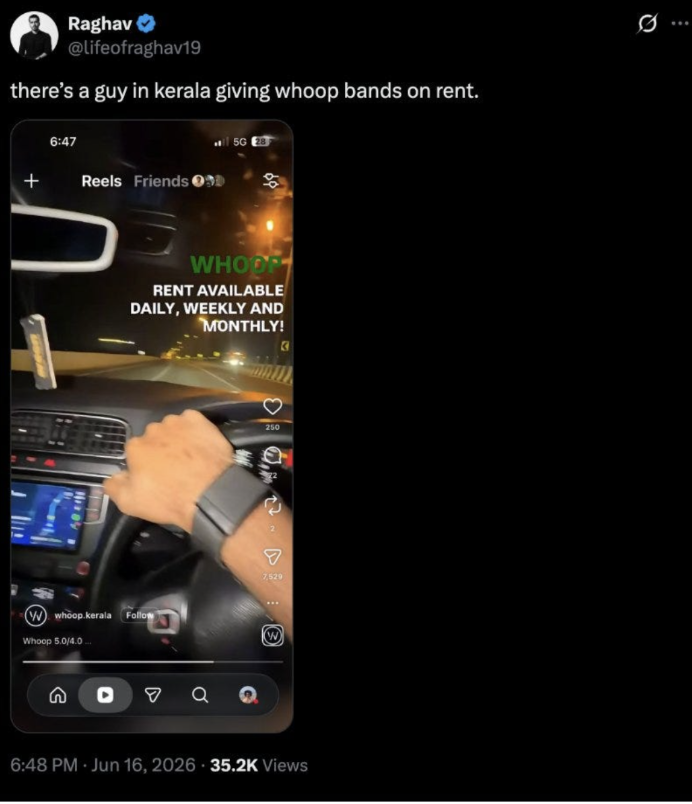
But then the café with the perfect wall and the perfect light turned out to be built backwards from the photo, so the coffee is basically incidental and what you’re really paying for is the aesthetic backdrop. The follower count that’s supposed to mean you’re worth following can be bought (and can be bots, pun intended). The Goa villa gets shot to look like Amalfi. There’s even a guy in Kerala renting out Whoop bands by the day, which means you can now rent the proof of a discipline you don’t have. So much for un-fakeable!
The cycle for status signalling is always the same. A signal is scarce, so it works for a while. Because it works, it attracts imitators. The imitators flood it. The scarcity dies, and the signal dies with it, and the crowd moves on to the next scarce thing and starts the clock again.
The interesting bit to me is why the clock is running so much faster than it used to? Why is “doing it for the gram” now an insult? And why have statuses started to be churned out way faster than ever before?
Why a signal that used to last a generation now lasts a season
The first is that the audience went global, and turned into a comparison engine. Your audience used to be your school, your college, your social circle, and for a lot of people that’s still the case. But as soon as you get an account, the audience is everyone - every person who might see you and assume from the evidence that you have taste.
The catch is that this runs both ways. The feed where you perform is the same feed where you watch everyone else perform: someone on the trip you’ve been wanting to take, or everyone visibly making things on a weekend and living their best lives. So your feed isn’t just a stage where you’re forced to perform, it’s also the reason your itch to signal gets evoked. You signal partly because you can’t stop watching everyone else signal.
The second is that signals became infinitely reproducible. Signal used to be that you did the thing, and then later you mentioned it to your social group. Now the doing and the documenting happen at the same moment. The run isn’t quite real until it’s a strava map, the dinner hasn’t fully happened until it’s a story, you might as well have not slept if your smartwatch didn’t capture your score. So the signal just gets born automatically - as a byproduct of living. And the effort going into documentation has essentially reduced by a mile.
Then the algorithm does the rest and finds whatever’s working and pushes it to everyone. You don’t copy the signal so much as the system copies it for you, fast and for free, until the thing that once felt special is everywhere and special to no one.
The third is that platforms are now actively manufacturing the signal. It’s easy to assume this is a story about social media, about how you show your life on Instagram or Twitter. But a whole wave of platforms now exists to manufacture signals.
First it was about having an intellectual persona. Your Wordle score you posted daily, or your Duolingo streak acted as signals that you were a person who did smart things with your free time. Then it became about taste and being plugged into the right pop culture. Your Letterboxd, your Goodreads, your Spotify top artists - all became shareable elements that said more about you than you ever would. And then it became about discipline, which is mostly where we are now. Your sleep score on Whoop, your protein & supplement intake, your Oura readiness, and whatever Temple is supposed to do in the near future.
In crux: the audience makes everyone want to signal more, the platforms keep manufacturing new things to signal with, and the whole system reproduces whatever works until it’s blasted on everyone’s screens. No wonder the signals burn out faster than they used to, we’ve built the machines that burn through them.
The performance of not performing
The rising flex now is the phone-free dinner, the trip not being posted real-time, the person who says “I don’t track my sleep, I just sleep because checking scores makes me anxious.” Not-documenting is the scarce signal now, precisely because everyone else can’t stop. Presence can’t be screenshotted, so presence becomes the prize.
Except I feel this escape soon gets eaten too. Authenticity isn’t un-fakeable; it’s just the current hardest-to-fake thing. For example, BeReal got popular because it was supposed to make performance obsolete - you were forced to post a spontaneous and unedited photo of yourself the moment it pinged you. However, enough surveys suggest people found a way around it by waiting intentionally for something interesting to happen before posting. Instagram’s new Instants is built on the same authenticity pitch, and will probably go the same way.
The most advanced form of performance turns out to be the performance of not performing, and it’s the oldest move there is. The Italians had a word for it 500 years ago: sprezzatura. It means studied carelessness - the ability to do something difficult - like producing a clever line of poetry or doing a graceful dance move back in the day - and make it look like it cost you nothing. The whole skill was in hiding the skill. In 16th century Italy, a courtier who’d clearly rehearsed was nobody; a courtier who seemed to toss it off without trying was everything. That’s exactly what’s happening now. Effortlessness hasn’t gotten out of style, even if it’s a manufactured perception.
So, what’s the next signal?
I know you are striving to ask this question, and so am I, but I don’t think there is a single one. Over the last decade, signal has broken into hundreds of tiny scenes, each with its own flex that means nothing outside its own room.
There’s the run club and the book club, the matcha spot and the coffee raves, the sleep crowd chasing a newer number every month. There’s the wellness world that five years ago was a couple of supplement brands and is now a whole identity. Padel, pickleball, clay dates, un-lectures, the elaborately well-spent weekend where you’re proving you touch grass. Each one is gold in its own room and means nothing in the next.
The only people who really escape it are the ones who aren’t on social media at all, and I’m not even sure that works anymore. The instinct to be seen living well finds you regardless.
On the contrary, I’d say don’t bother trying to escape it entirely. That feels both impossible and slightly dishonest. We are all signalling in some form, whether through what we post, what we intentionally don’t post or the people we want to be associated with. Over a conversation with a few colleagues, we concluded that spending 1.5 hours actually participating in an activity and then 30 minutes arranging it into a post is still a better outcome than spending 2 hours doomscrolling.
The performance of experience may be odd, even unsettling, but it has also pushed people towards newer forms of participation. It has made leisure more active, consumption more embodied, and hobbies more socially legible. Someone may join a run club or try to finish a marathon because it photographs well, but they still ran.
The entry point being performative doesn't really matter. Increasingly, many things are. What’s worth sitting with is whether the performance exhausts itself in a post. If you do the thing once, photograph it and never return to it, then maybe the signal was the whole reason why you started. But if you commit to it for at least the medium term, if you return to it after the novelty has faded, if it continues to occupy your time when there is no immediate social reward attached to it, then performance can soon become practice - and not all of it is hollow.
There's an increasingly thin line between doing the thing because it counts everywhere and doing it because it counts to you. I just think it's worth staying on the right side of it, even as that line gets blurrier than I'd like to admit.