
How we think about supply-side moats in a world where code costs nothing
Arjun Malhotra & Amani Chowdhry
Sep 17, 2026
Until recently, enterprises built most AI agents: software that answered support tickets or reconciled invoices in the back office. Over the past couple of years, people got used to asking AI chat windows for answers. Now that models can use browsers and act across connected accounts, asking the same window to carry out the task is the natural next step. In September this year, they began arriving as consumer products: Meta launched Muse, OpenAI followed with Dots, while Instinct, which launched in August, closed a round at $10bn, with a team of only 14.
What separates these products from chatbots is how much they can get done unsupervised. If you give Muse access to your email, calendar, and card, it can navigate your accounts, fill in details, compare prices, and place orders. The chat window has become an effective way to delegate tasks. This design assumes that whatever sits on the other side of the task can be done by software. In the US, where most consumer services run on connected digital backends, an agent can finish the job through the accounts and services it can reach.
So what comes next?
In India, a less digitally connected economy, errands take a more analog route even when they begin online. Imagine filing a reimbursement claim on a family health policy. You upload the papers to the insurer’s portal and think you’re done. Then the administrator emails asking for a pharmacy bill the hospital never issued. The hospital’s billing desk asks for a request on letterhead. You send it in, wait, and the insurer comes back with another query. The claim has moved from a portal to an inbox, a phone line, and a counter. The steps are manageable; keeping the whole thing moving is the work.
Families have always found someone to take on that work: a CA, an insurance agent, an RTO agent, or a relative who keeps calling until there’s an answer. These tasks need a person who can carry the details from one step to the next and keep following up. Indian startups building agents naturally come from this starting point so the results look quite different from a Muse or Instinct.
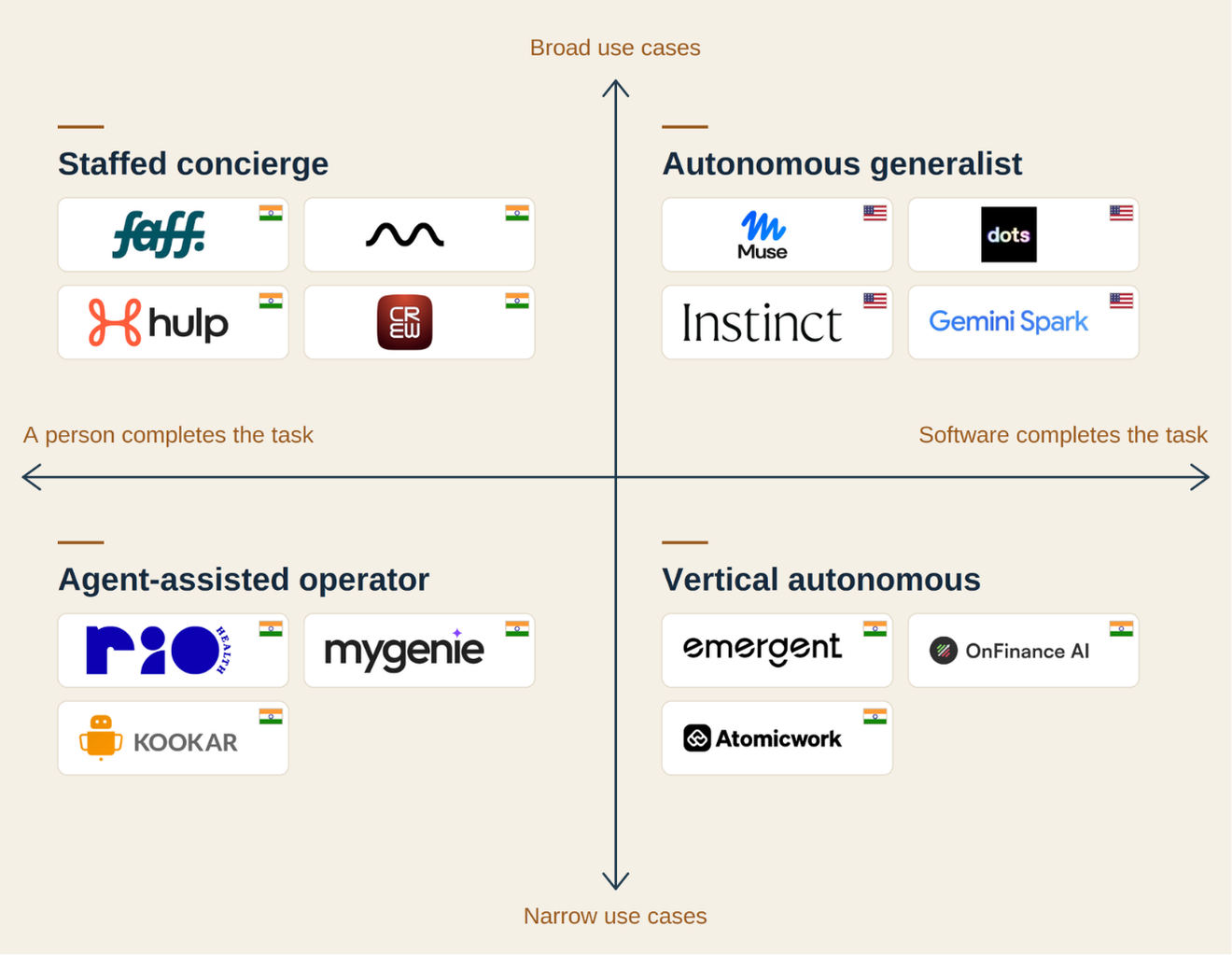
We can group these companies across two dimensions. On the left are tasks completed by humans, and on the right are those completed by software. The vertical axis has narrow use cases at the bottom, with broader use cases at the top.
The consumer products in the top-right are mostly American. Indian founders are also building agents on the right side of the chart where task can be completed entirely through software, though these sit in the bottom-right around defined business workflows. Emergent works with codebases, OnFinance with financial data, and Atomicwork with IT tickets: tasks where the relevant information and actions are accessible digitally.
The Indian startups on the left have converged on a combination. These startups use AI to coordinate the task, while a person gets things done in the real world. This is the orchestration layer we described in the previous editions.
In our portfolio, this approach is already working in the bottom-left, where it is built into a defined workflow. At construction company MyGenie, AI sequences material and labour requirements across sites, giving a small contractor the kind of scheduling a large developer might assign to a planning team, while the actual building is done by humans. At Rio Health, customers send prescriptions on WhatsApp as a photo, voice note, or text. AI reads the prescription and prepares the order, then a licensed pharmacist checks it before anything leaves the dark store. In each case, the human is the accountable step in the physical world,, and the AI keeps the job from slipping.
The open question is whether the same approach can extend upward into the top-left, where many of this year’s newer Indian agents take on household requests (with a person doing the work and AI keeping track of it). Hulp lets households send a voice note on WhatsApp, then assigns the task to a human assistant supported by AI workflows. M uses AI to run the household kitchen, briefing the cook over voice notes in their own language. Other services have been working in this space for longer. Swiggy Crew, a premium concierge, has recently narrowed its focus to travel. Faff remains a personal assistant for whatever a household hands over.
Faff is probably the broadest of these services, and the company says it handled more than 500 refunds, warranty claims and repairs in a single month. In one case, an airline had sent a cancelled-flight refund to the travel site the customer had booked through. The money sat there for weeks. The site dealt with refund queries by phone, and each call ended with a promise to check back. A Faff operator kept calling until someone found the mistake.
This is also the hardest quadrant to scale. When requests vary, the work learned from one case may not transfer neatly to the next, and the time an assistant spends on each task can be hard to spread across more customers. India’s first wave of chat assistants ran into this problem in 2015–16. Haptik and Helpchat began with users messaging teams of human assistants who booked, ordered and followed up on their behalf. Helpchat shut its chat operations in 2016, and Haptik moved to building chatbots for businesses.
What has changed since 2016 is the cost of coordination. In a case like a refund or an insurance claim, an AI layer can track the state of the case, remember when to follow up, pull the right documents and contact details, and brief the user before they get on the phone. The human still handles the parts that require dealing directly with someone, and less of their time goes into keeping the details straight. M’s founder, Kabeer Biswas, knows this category from its earlier wave: he co-founded Dunzo, which originally began as a personal task service. He is building in the same broad space again, with AI taking on more of the coordination.
The details of a process can change from one place to another. A vehicle transfer follows different rules in different states; insurers can vary in what paperwork they accept and how they want a query handled. To move a case forward, an operator has to learn which office to contact, what to ask for, what documents will be accepted, and when to follow up. That knowledge comes from handling the work repeatedly. Over time, a service can build a clearer picture of where cases get stuck and what helps move them along.
India’s digital public infrastructure – state-built identity, payments, and document systems – has made some of these errands easier for software to handle, and that reach may grow. Still, a digital step does not always complete the task. A claim may still need a call, a transfer may need a visit, and a query may need someone to find the right person to answer it. An agent can carry the context across those handoffs, so the person handling the next step knows what has happened and what needs to happen now. The opportunity in India is to build agents around that combination of accumulated local knowledge, AI coordination, and human follow-through.
Arjun Malhotra & Amani Chowdhry
Sep 17, 2026

Amani Chowdhry & Arjun Malhotra
Sep 10, 2026
Amani Chowdhry
Jul 10, 2026
Arjun Malhotra & Amani Chowdhry
Aug 22, 2025
Arjun Malhotra & Amani Chowdhry
Aug 8, 2025

Arjun Malhotra & Amani Chowdhry
May 16, 2025
Stay Ahead of the Curve
Contact
Find the team member whose focus overlaps with what you’re building, or someone we both know who can introduce you.