How we think about supply-side moats in a world where code costs nothing
Arjun Malhotra & Amani Chowdhry
Sep 17, 2026
By Amani Chowdhry & Arjun Malhotra
Sep 10, 2026

In 2015, sitting in a small Bengaluru women's-wear boutique called Estilocanta, Vidit Aatrey asked the shopkeeper how business was going. The answer became the blueprint for Meesho. Half the shopkeeper’s sales came through WhatsApp. She had built a WhatsApp group containing every customer who had ever walked into the shop; when new stock arrived, she photographed it and posted it to the group; when somebody wanted an item, she sent a delivery boy to their house to collect cash. The customer never entered the store: there was no formal catalogue software, no website, no payment gateway. In 2015, there was no WhatsApp Business app to install either, and it wouldn't exist for another 3 years.
To visualise the scale of India’s informal economy, simply multiply this single shopkeeper’s workflow across tens of millions of merchants. India’s small business landscape comprises over 70 million entities, yet fewer than 5 million have adopted formal e-commerce channels. The vast majority of economic activity bypasses the traditional digital marketplace entirely, taking place within the intimacy of a conversation thread instead. For the merchant lacking a dedicated website, CRM, or billing suite, WhatsApp is the entire business operating system.
It became the default business OS precisely because everything already lives there - family groups, residential/RWA groups, personal and professional threads; the entire universe of a merchant's trusted networks is inside one app. Hence, for merchants, it serves simultaneously as a storefront, catalogue, order book, and billing counter. Commerce here persists in the chat because, in the Indian market, the relationship is the key customer acquisition channel.
Merchants gravitated to WhatsApp for reasons that traditional platforms couldn't satisfy. Most marketplaces were restrictive - they hijacked buyer identities, mandated return terms the seller had to absorb, and commoditized shops into one listing among thousands.
WhatsApp, by contrast, was frictionless for the seller as well as the consumer, and hence became the path of least resistance for both parties. While marketplaces demand standardisation (fixed prices, rigid SKUs, and static return windows), roughly ~75% of Indian retail is unbranded, custom, negotiable, and frequently sold on credit. WhatsApp provided a canvas for the messy and relational nature of Indian trade.
Meta took a small step in 2018 with the WhatsApp Business App and API. Yet, Meta could not impose specific commerce workflows without bloating the experience for the vast majority of users who are there just to chat.
This vacuum gave rise to the first wave of WhatsApp-native Indian startups (like WATI, AiSensy, Interakt, and DelightChat). These operators digitised the merchant-customer relationship without breaking the intimacy of the chat. By wrapping their own commerce logic around Meta’s raw infrastructure, they solved the messy drudgery that Meta couldn't touch without compromising its own scale.
Their success lay in building verticalised software – tools that understood the chaotic, real-world constraints of Indian retail. Instead of one-size-fits-all tools, they built precise workflows to solve the operational friction that fragmented the market, like:
Meta, meanwhile, attempted to bridge this gap by adding features directly to WhatsApp. They launched WhatsApp Pay (2022), the Cloud API for developers, and 'WhatsApp Flows' for in-chat catalogues and forms. These tools were essentially sophisticated plumbing - they moved messages and money, but they didn't facilitate the actual trade. Because they were built as generic and horizontal features, they failed to capture the nuances of business. 6 years after launch, WhatsApp Pay handles only ~0.65% of India's UPI volume, ranking ninth. Meta succeeded in building the world's most efficient communication backbone, but in treating commerce as a technical integration problem rather than a trust-and-workflow problem, it missed the actual sale.
Meta faces a classic monetization paradox in India: it is their largest market by users but among their smallest by revenue per user. To move beyond the limitations of ad revenue, they are building a professional "business surface." By appointing CRED’s Kunal Shah to lead WhatsApp globally, Meta has moved beyond simple messaging toward building critical financial infrastructure. Now, their WhatsApp Business API is rapidly evolving into a rail for embedded lending by enabling credit underwriting, loan disbursements, and automated collections that were previously siloed. Their strategic goal – creating an ecosystem that facilitates the credit and settlement flows powering the Indian economy – underpins their recent push for verified identities and the integration of AI agents.
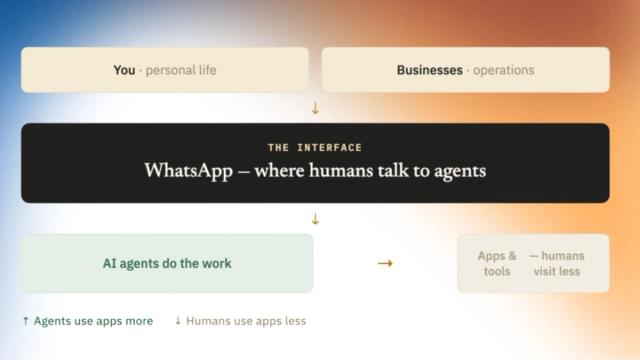
In June 2026, Meta launched its global "Business Agent," a horizontal engine designed to automate high-frequency tasks - like FAQs, order tracking, and lead qualification - across every business on the platform. By pricing this utility per token, Meta has fundamentally shifted its revenue model: they are moving beyond selling message volume to monetizing the intelligence layer itself.
While some view this as an encroachment on the vertical startups that built their businesses on WhatsApp, we read it differently. Meta can commoditize routine operations, but it cannot replicate the judgment required to drive a sale. An API can report that an order shipped, but it cannot determine how a boutique handles a complex return, or how a clinic prioritizes its intake list. That trade-specific judgment is precisely what a customer is trusting when they transact.
Meta’s release of horizontal "Business Agents" is a necessary platform upgrade, but it remains a baseline utility - not a business in itself. The real leverage for the next decade of Indian commerce doesn't lie in these generic features, but in the "opinionated" intelligence built on top of them. This is the core of our Vertical Workflow-Integrated AI thesis.
We see this approach as a fundamental shift in how technology integrates with Indian expertise. Highly skilled professionals - whether in clinics, law firms, or education - spend 60–70% of their time on administrative tasks. Most horizontal AI tools fail here because they require the professional to act as a "bridge," manually feeding context into the bot. Vertical Workflow-Integrated AI solves this by acting as an invisible conductor, maintaining deep domain context - like patient history or legal contract status - to automate coordination without breaking the professional’s existing routine.
This brings us back to our starting point: when Meesho first scaled, they embraced the inherent informality of trade happening on WhatsApp and proved that formalising commerce where it already lives is the massive prize.
The next generation of WhatsApp-native giants will be vertical operators who build the “brains” - for credit, logistics, and fulfillment - that generic AI will always lack.
Arjun Malhotra & Amani Chowdhry
Sep 17, 2026
Amani Chowdhry
Jul 10, 2026

Amani Chowdhry
Jun 5, 2026
Radika Agarwal
Aug 6, 2026
Shreyans Salecha
Jul 29, 2026
Amani Chowdhry
Jul 10, 2026
Stay Ahead of the Curve
Contact
Find the team member whose focus overlaps with what you’re building, or someone we both know who can introduce you.