
The Anatomy of a VC Analyst Call: What to Really Expect
Sharvi Dubey
Jan 31, 2025

This article is part of a larger series on Deal Closing. Click here to access all our modules.
Once a term sheet is signed, the lead investor will engage legal counsel, who will initiate the drafting of “definitive transaction documents”.
Transaction documents embody the commercial arrangement agreed to in the term sheet, are far more detailed (with more legalese), consider the local compliance requirements, and are legally binding. These definitive transaction documents allow you to accept the investment while following the correct regulatory process.
Paperwork & processes differ across countries. A more mature market like the US has publicly available standardized documents. E.g. the SAFE for pre-seed and seed transactions.
The regulatory framework in India is a lot more complicated. There are multiple different instruments and nuances, making the standardization of documentation a confusing and cumbersome process.
However, there has been a consistent effort to standardize and make transactions more efficient across the ecosystem.
At an early stage, 3 different types of documents are commonly used:
We’re going to dive deeper into each of these in the next section(s), and cover what their advantages, norms, and use cases are along with some time spent on declassifying Convertible Debt Instruments, commercial terms, and end with how timelines for all of this works
PS. A special thanks to Shepherd Law for helping out with all the draft documents linked in this playbook 🥰
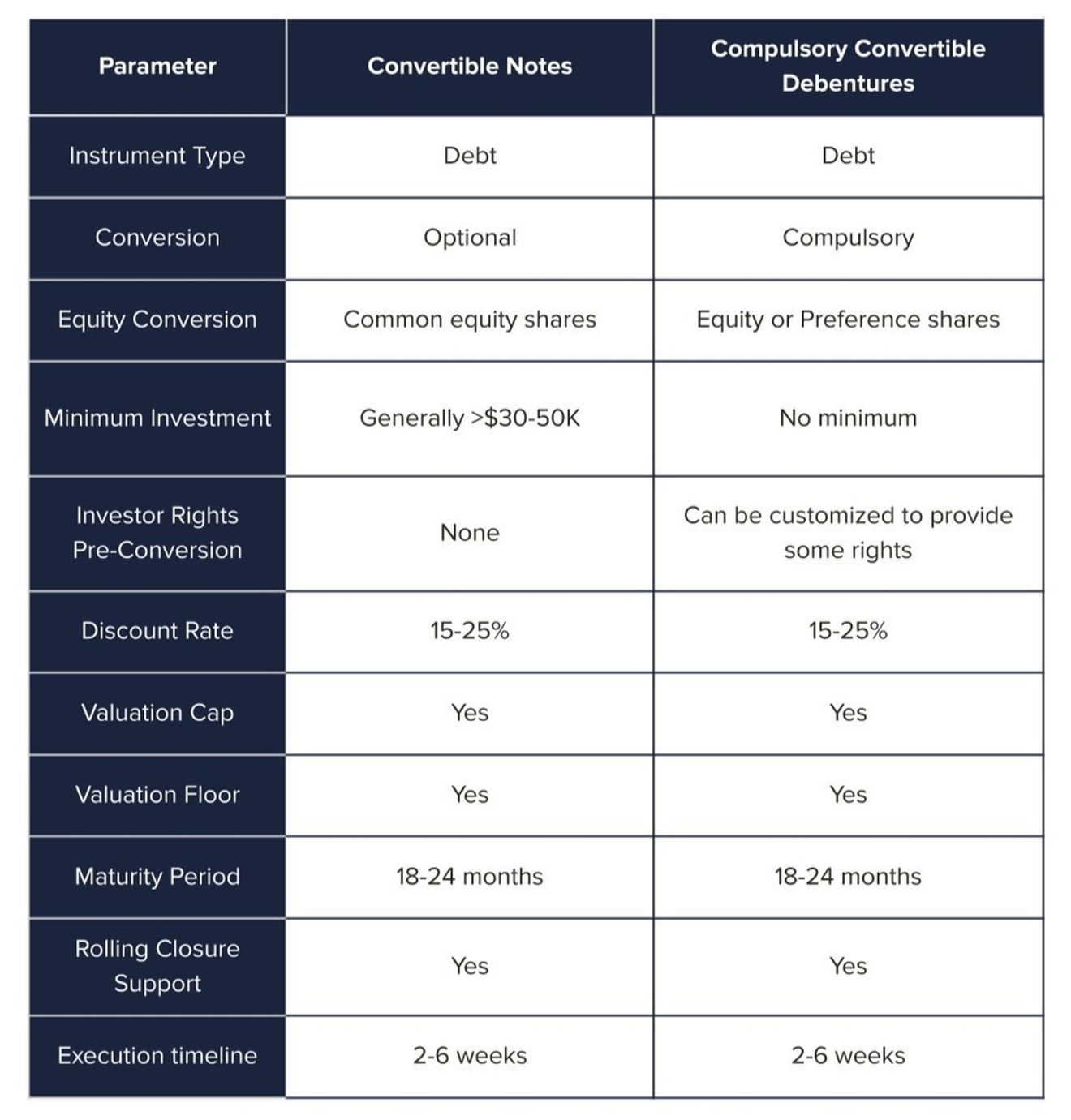
We go over both of these instruments in detail in the following sections.
A convertible note (CN) is a short-term debt instrument that early stage startups use to raise funds from investors. It allows investors to loan money to a startup and "convert" the loan amount into equity shares of the company in the future, typically at a discounted conversion price.
Key terms associated with Convertible Notes
Pros of using Convertible Notes
For example, Investor A puts $50K on Jan 1st, Investor B puts $30K on Jan 15th. Both can get the same discount and terms when converting to equity later.
Cons of using Convertible Notes
Even if noteholders don't yet have investor rights, startups commonly provide basic information sharing and inspection privileges as a gesture of goodwill to major note investors.
The deferred, uncertain nature of convertible notes does mean investors take higher risk with respect to the governance setup of the organization and the rights given to them. Generally, the discount rate, valuation caps, etc. are favorable enough to make it worthwhile.
In summary, when structured properly and aligned to investor interests, convertible notes allow early-stage startups to kickstart fundraising momentum without struggling over elusive valuations.
A compulsory convertible debenture (CCD) is a debt instrument used by early-stage Indian startups to raise investor funding that compulsorily converts into equity shares in the future.
An iSAFE functions similarly but is based on the US SAFE model adapted to India. The terms of a CCD and iSAFE are fairly similar in practice. As a founder, there is little difference between the both and the choice is often determined by the investor’s legal preferences.
Both are simple, standardized agreements allowing founders to efficiently close investment rounds before finalizing on a valuation.
Pros of using CCDs and iSAFEs
Cons of using CCDs and iSAFEs
In summary, CCDs and iSAFEs balance both founder and investor interests on key issues like rights, valuations and risk/return better than traditional convertible notes in most cases. The standardized documents help expedite closures.
Shareholder Agreements (SHAs) and Share Subscription Agreements (SSAs) are the definitive equity round transaction documents preferred by institutional investors in India.
While complex and lengthy, they allow investors to get formal shareholder rights and enforce important governance practices in startups they invest in.
Key Terms associated with SSAs and SHAs
🚨 P.S: These are all terms we have covered in the previous section of this playbook. You can read it here. 🚨
Pros of using SHAs and SSAs
Cons of using SHAs and SSAs
In essence, SHAs and SSAs provide unmatched legitimacy and rigor demanded by institutional investors. But they work best once startups have achieved product-market fit and some scale.
Given our experience in this closing process, we are going to cover the commercial terms below that have not been previously looked into in other sections of this playbook.
Vesting
Founders have a certain number of shares in the company - obviously, they are generally the largest individual shareholders through the first few rounds.
Based on the lock-in period (previously deconstructed) at term sheet stage and the agreed vesting schedule, there will be some portion of shares that are vested for the founder and some that are unvested.
💭A vested share is one that you have fully earned and own outright. Practically, this means that you can sell this share.
An unvested share is one that you own but are yet to earn which happens per the vesting schedule or on the occurrence of an event such as exit. 💭
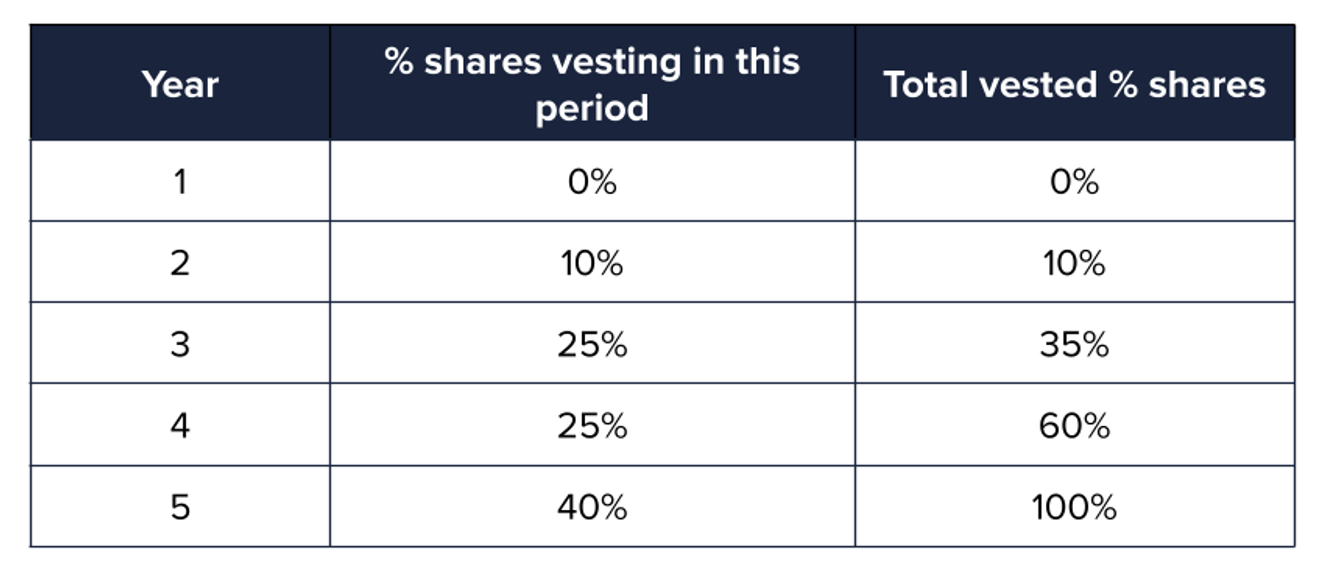
Here’s a hypothetical 💡
Let's say you have a typical 5-year vesting period, this is what the breakdown of those 5 years could look like, basis the given vesting schedule:
Leaver Provisions
In case the founder wants to exit the company before the shares are fully vested, there can be 2 scenarios that play out:
A situation when the investors, remaining co-founders and you mutually consent to the Founder to be exiting the company.
All vested shares plus the shares that would have vested within that year will typically hold fair market value, and it falls on the exiting founder to try and find a buyer for liquidity.
The unvested shares in this situation are bought back by the company at face value, and are usually transferred to the ESOP pool of the Company.
It is important to note that even in a good leaver situation, the voting rights of the founder cease to be in effect once the employment is terminated.
A situation of disagreement between the founder(s) and the other shareholders on an act or decision that goes against the stipulated responsibilities of the said founder(s); with no resolution in sight.
All vested and unvested shares of the exiting founder will typically be bought back by the company at face value.
While the above is fairly standard, there are different ways that good & bad leaver situations can be tackled and we always recommend that, as the founder, you should have an employment agreement with the company that covers various scenarios and acceptable outcomes, much like you would create with the critical talent that you end up hiring for your firm.
As a supplement, you can also have an agreement between the co-founders that covers various conflict scenarios and how they need to be handled. If such a document isn’t created, the conflict will either be investigated and final say will be decided by the board, or you can choose to hire a third-party expert wherein the final decision provided by them at the time will be applicable.
Affirmative Vote Matters
Affirmative Vote Matters (or Investor Approval Matters) are typically a list of items for which a company will need to take consent from their lead investor prior to actioning. This is a list of 20-odd items (found in our draft SHA- Schedule 6) that effectively relate to the structure of the company; such as financial decisions made over certain thresholds, any key employee changes, any regulatory or IP changes that may be applicable.
All of these might sound daunting but it's important to remember that having these investor approval matters is beneficial to maintain a compliant company. A list of potential AVMs is given in the draft document that's attached and I would encourage you to go through it. Keep in mind that these may alter depending on what level of control your investor might want to have in the company.
Fallaway threshold
The concept of fallaway threshold is not common at an early stage, but is more a commercial concept that can be introduced at seed & future rounds if needed.
Effectively it means that when an investor’s shareholding reduces below a certain percentage, certain rights will not apply to them anymore. For example, if your lead investor holds 10% in the company today, at the time when their shareholding drops below 5% (this is your fallaway threshold), the investor will no longer have the right to be on the board or exercise drag right or have affirmative voting matters etc.
Reps and Warranties
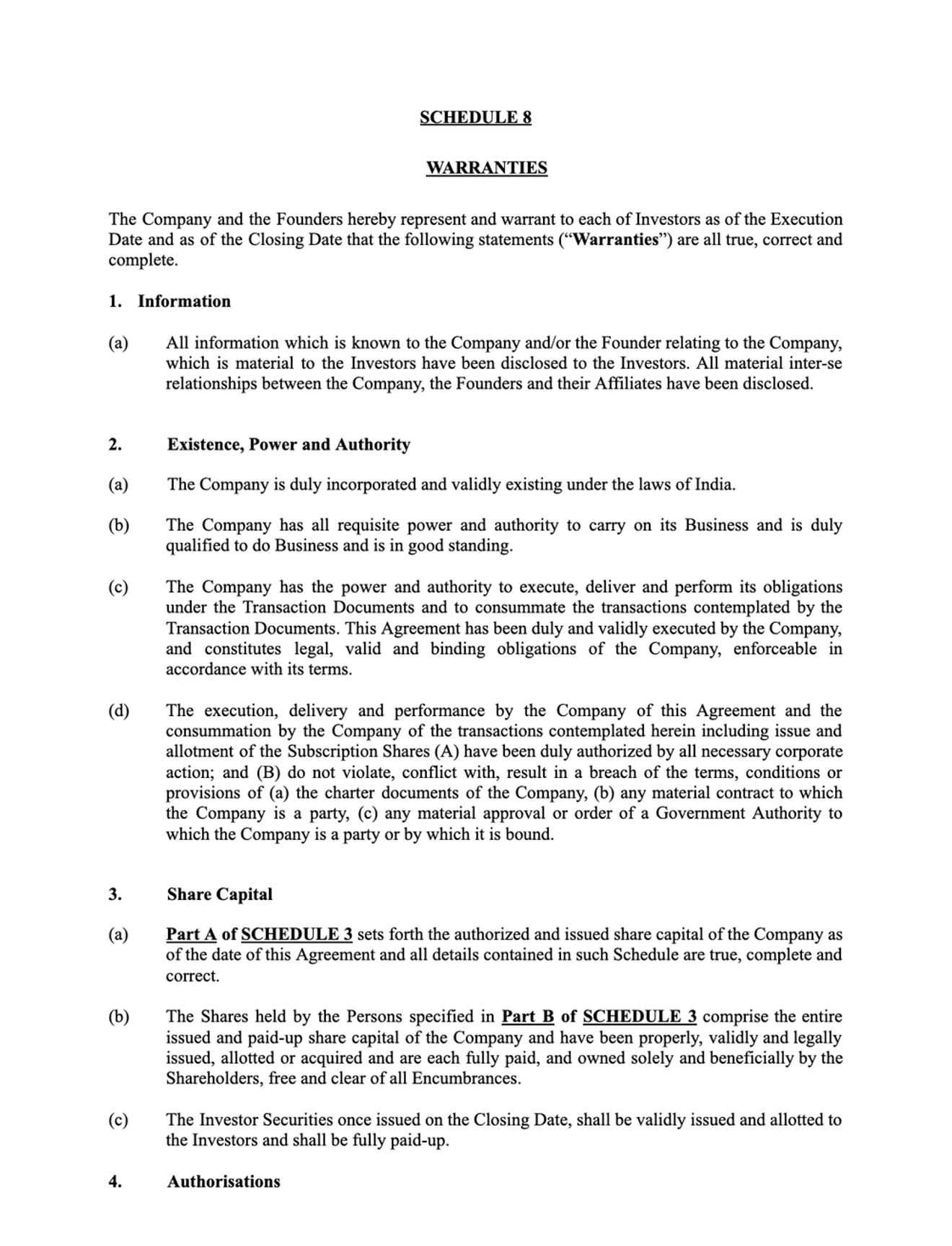
In any transaction, it is typical for the company and the founders to make certain representations.
🚨 A representation is an assertion as to a fact, true on the date the representation is made, that is given to induce another party to enter into a contract or take some other action.🚨
For example- the company has been incorporated rightfully, the company has no debt, the company can enter into such a transaction etc.
🚨 A warranty is a promise of indemnity if the assertion is false.🚨
Your investors are deciding to invest in the company, based on the information and knowledge that you have shared which need to hold true for the deal to stand. Please note, reps are given by the founder(s), and the company as applicable - these are covered in detail in the Share Subscription Agreement.
Indemnity
An indemnity is a contractual obligation of one party to compensate the loss incurred by another party due to the relevant acts of the Indemnitor or any other party.
Based on the representations and warranties that a founder and the company give, the concept of Indemnity kicks in which effectively means that your investor is indemnified against if any of these reps and warranties are incorrect.
Closing the SHA & SSA i.e. aligning on all the commercials before you’re ready to sign can take a fair bit of time and involves a lot of different steps. Let’s break these down:
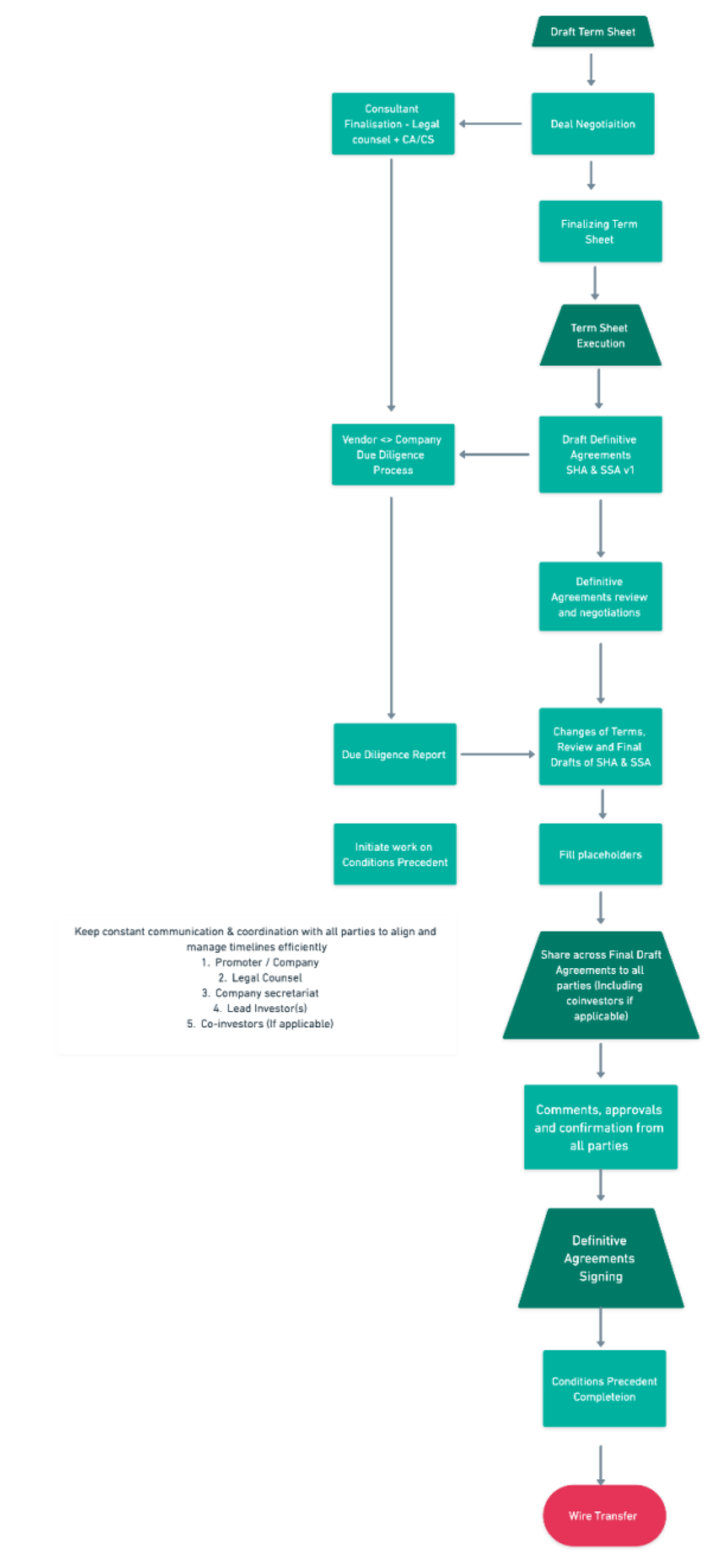
A blanket rule to ensure that this entire closing process is handled efficiently and optimally is by getting a well referenced, practical legal counsel to guide you through terms, and to have an experienced CA/CS which guides you through the entire transaction & closing process.
Congratulations, you have completed yet another important step in your deal-closing journey! Follow along in our series as we break down more elements. If you found this helpful, please do share it forward and more importantly tag us on social media 🥰
Sharvi Dubey
Jan 31, 2025
Sharvi Dubey
Jan 17, 2025
Sharvi Dubey
Nov 20, 2024

Shreyans Salecha
Jun 19, 2026

Shreyans Salecha
Apr 21, 2026

Shreyans Salecha
Mar 13, 2026
Stay Ahead of the Curve
Contact
Find the team member whose focus overlaps with what you’re building, or someone we both know who can introduce you.