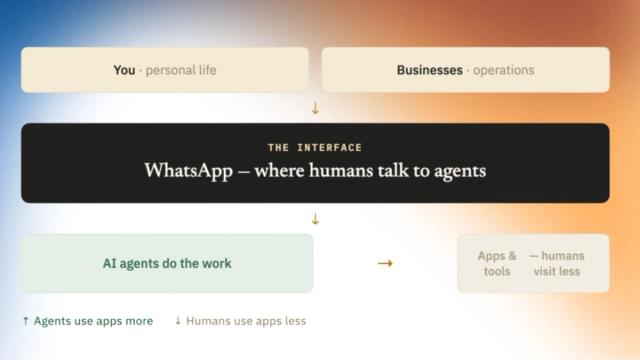
Cred without Kunal, WhatsApp with him
Shreyans Salecha
Jul 29, 2026

Here’s what we’ve seen in consumer AI in 2025 and what we think of these ideas:
The first wave: figuring out what AI could do
The initial iteration was largely exploratory. It was mostly agents with voice and chat capabilities, and in hindsight, this phase was more about founders tinkering with use cases to understand what people would actually want and how they'd want to use it.
Use cases we saw most frequently: health & nutrition, mental wellness, wealth management, job search, travel. Most products from this wave have since evolved and narrowed into something more specific - which is the right direction, and something we're seeing more of now.
AI personal assistants for the cash-rich & time-poor
Next came a wave of AI personal assistants. The product offering ranged from pure AI products to concierge services enabled by AI. One founder put it aptly - they were targeting "cash-rich, time-poor" people: mostly urban couples where both partners are working, or the DINKs of India's metros. The promise was simple: offload all the odd jobs that eat up your day - searching for travel, ordering groceries, making local event reservations, and finding things to buy.
What emerged were two distinct categories.
One of the more interesting exceptions we've seen is in kitchen management. An example here is Kookar AI. It interfaces with the home cook via WhatsApp - in voice, in the cook's native language - to supervise meal preparation, log what's in the kitchen, and order groceries automatically through AI agents across commerce platforms. This one is interesting because it solves a very specific, very recurring frustration, and it keeps a human - the cook - squarely at the centre of the workflow.
AI companions: the loneliness play
Then came AI companions, targeting a problem that, in the non-AI world, had already been solved profitably through chat room apps and anonymous voice calls. Because the earlier versions had worked, there was a reasonable case that the AI versions could do better. This was probably the first category in consumer AI to attract meaningful capital.
We've seen strong founding teams take very different approaches here: building a single AI persona, creating multiple AI personas users can pick from, giving companions detailed backstories to make them feel more human, or, in some cases, simply not telling users whether they're speaking to a person or an AI.
Teams are also leaning on established acquisition playbooks, primarily performance marketing. The result, however, is very little differentiation in either product or go-to-market. Some products are already at scale or beginning to grow, but what remains to be seen is how any of them meaningfully differentiate, and how they choose to monetise.
There's also a path question that most people know about but few say out loud: a lot of these AI companions are, functionally, heading toward the chat and voice equivalent of OnlyFans. Some founding teams have made a deliberate choice to block that path and pursue use cases with lower initial engagement but higher long-term stickiness. That's the harder but more interesting bet.
One startup that we find interesting here is GuppShupp. Their insight was that Bharat users don't particularly care whether the entity they're talking to is human or AI - what they care about is whether their problem is getting solved. It's a different philosophy from most players in this space, and a more honest one in our opinion.
Vertical use cases: where it gets interesting
Most recently, we're seeing a wave of vertical AI products - refined versions of the first iteration, purpose-built for specific contexts rather than general use.
A few categories with the most activity:
A few things we find genuinely interesting
Looking ahead, a few categories seem underexplored relative to their potential:
What holds across all of this
The consumer AI products that have the best chance of enduring share a few things. They solve a problem specific enough that the user feels seen. They keep a human in the loop where trust and familiarity matter - whether that's a cook, a creator, or a coach. And they find a reason to be used again tomorrow, not just today.
India's market adds a layer of nuance here: the most compelling consumer AI we're seeing isn't replacing existing human relationships and workflows, it's making them work better. That distinction matters more than it might seem. An AI that sidelines the human might win on paper; one that empowers them tends to win in practice.
Shreyans Salecha
Jul 29, 2026

Shreyans Salecha
Jun 19, 2026
Shreyans Salecha
Apr 21, 2026
Shreyans Salecha
Jun 19, 2026
Shreyans Salecha
Apr 21, 2026

Shreyans Salecha
Feb 9, 2026
Stay Ahead of the Curve
Contact
Find the team member whose focus overlaps with what you’re building, or someone we both know who can introduce you.