
Your app is dying, but your business might be fine
Before I start, the alternate subject line that Claude helped me come up with for this newsletter was "The interface is dead. Long live the infrastructure." While another one made the cut because I love rhymes, I think this gives a great TLDR of what today’s newsletter will be about.
If you’ve been active on tech Twitter/LinkedIn, you would know that Swiggy has launched its MCP integrations across Claude, ChatGPT, and Gemini. This basically means you can now order biryani without opening their app - just tell your AI assistant, and it handles everything.
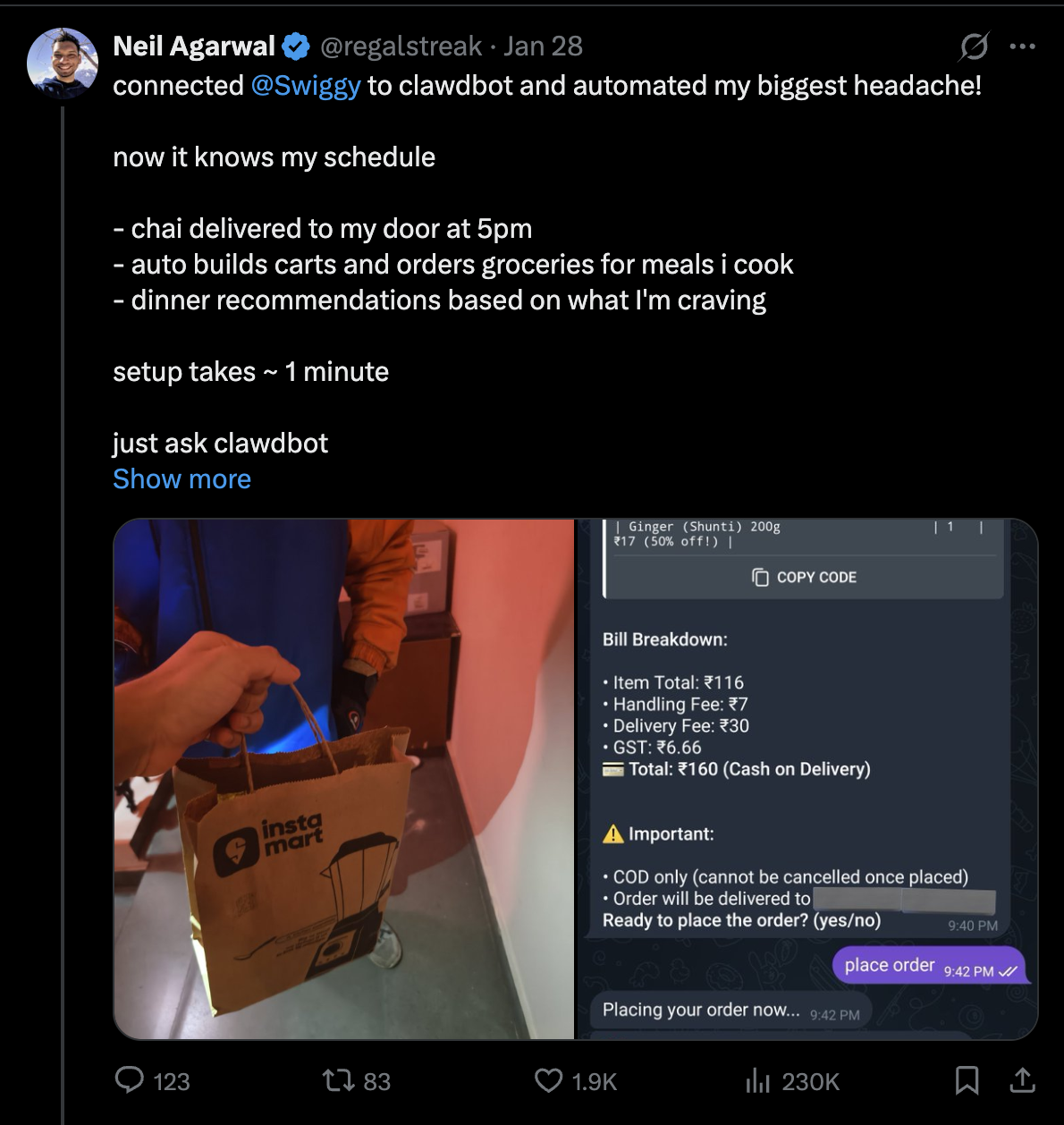
Zomato will likely follow within weeks (they always do). But what's interesting isn't the integration itself but that the company does not seem worried. There’s been no hedging and no PR about preserving the app experience. They're leaning in completely to use AI to enhance the consumer experience.
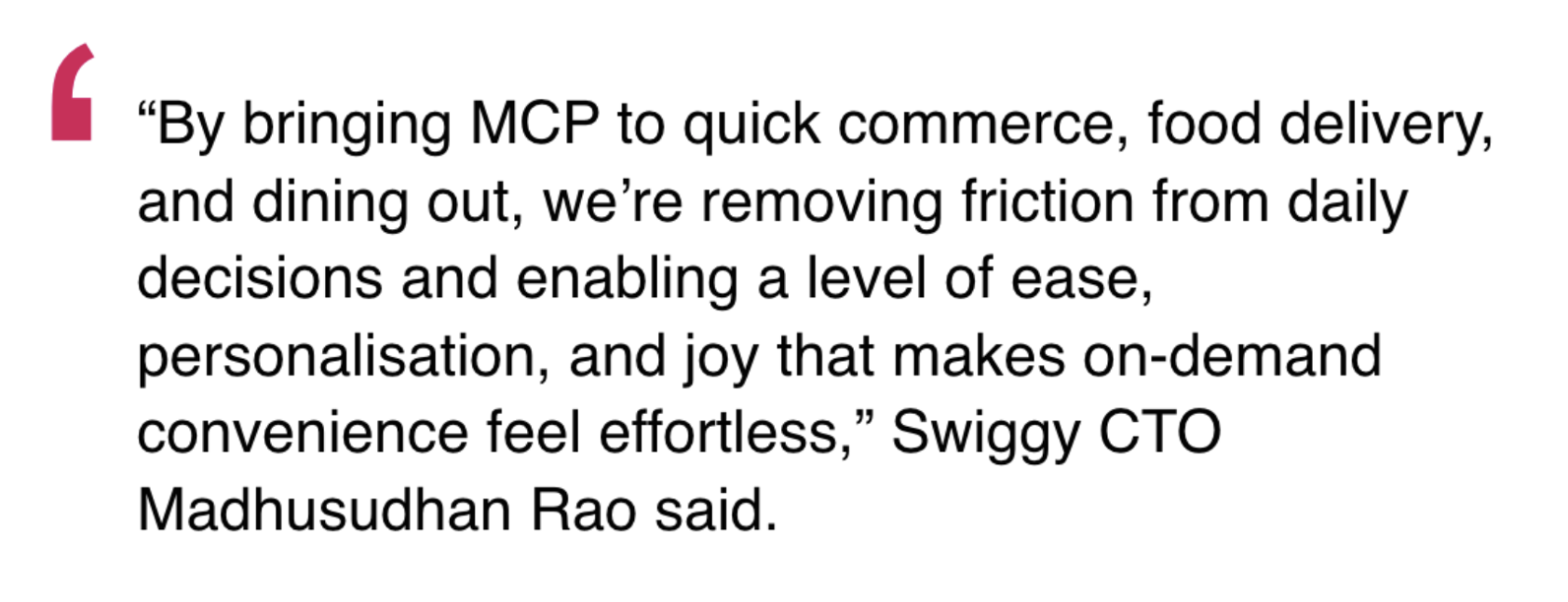
While this may seem like surface-level confidence, I think it shows something interesting about how marketplaces are both embracing and avoiding AI. Let’s take a step back to understand.
For decades, companies competed to capture users' attention and keep them inside proprietary apps. The business model was simple: build a better interface, create habit loops, and maximise time-in-app. Success meant becoming a destination that users deliberately visited, but that paradigm is ending dead.
Apps are transitioning from destinations to infrastructure. AI agents will increasingly serve as the primary interface, meeting users wherever they already are - in chat applications like WhatsApp, voice assistants, or ambient computing environments.
Tangentially, this also aligns with our Integrated AI thesis: the best products integrate deeply into existing workflows rather than forcing users to adopt new ones. Users don't want to context-switch between ten different applications to accomplish related tasks. They want to state their intent once and have intelligent systems coordinate the necessary actions across multiple services.
In this paradigm, your "application" can be diluted to an API that AI agents call on behalf of users. The interface layer hence becomes optional, or if I may say, “the interface is dead, long live the infrastructure."
Having said that, the marketplace and commerce ecosystems are splitting into two distinct camps:
Embracing integration: Platforms that are treating AI agents as a natural evolution of their distribution strategy, and an obvious way to enhance the user experience.
Defensive silence: Platforms that have remained notably silent about AI integration strategies.
But why this difference? Because not all marketplaces are created equal.
The defensibility framework
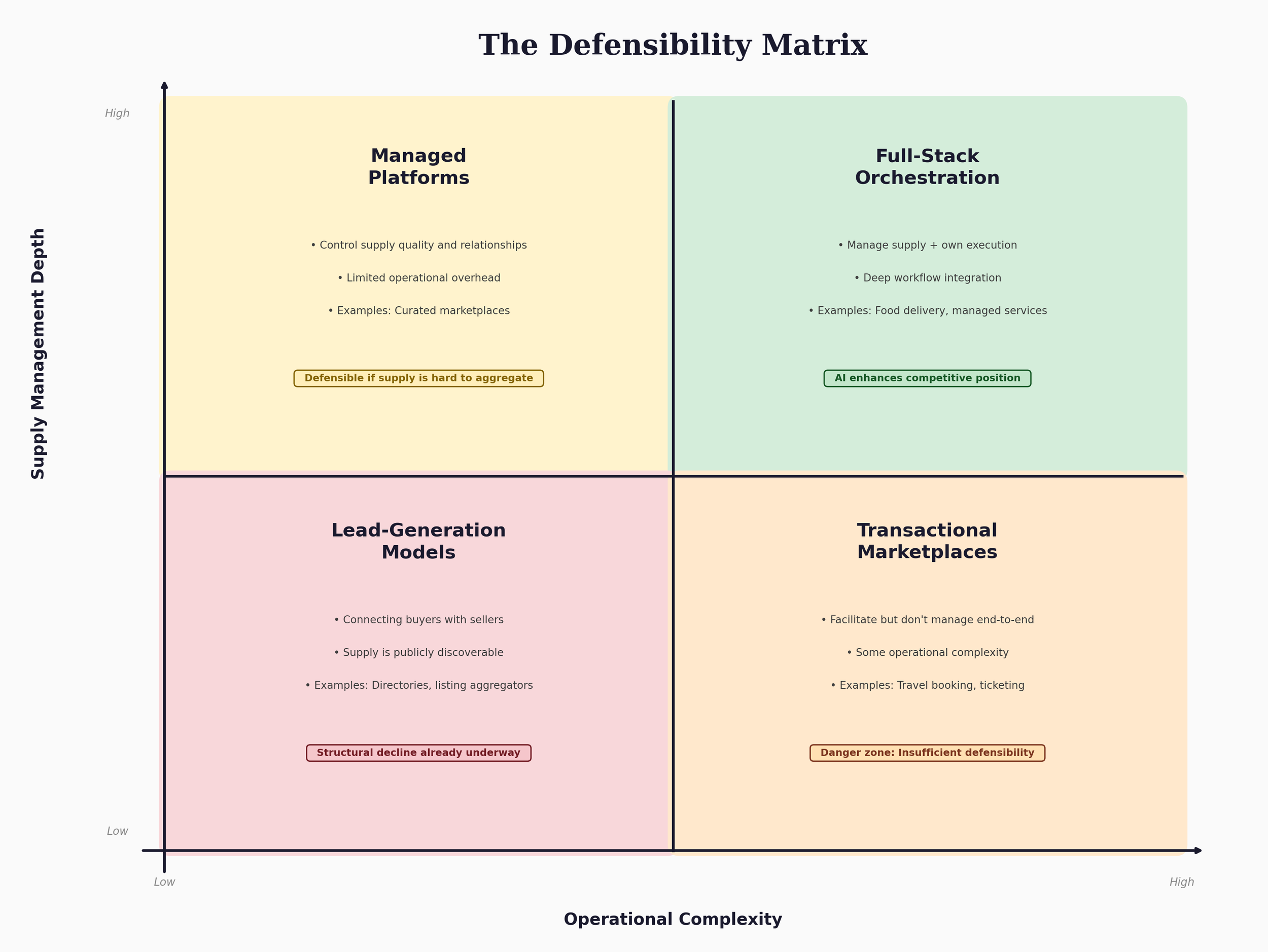
To understand which businesses survive this transition, consider two dimensions:
Supply management depth: Does it merely connect users with independent suppliers, or does it actively manage supply quality, relationships, and operations?
Operational complexity: Does it facilitate simple transactions, or does it own the complex operational workflows that deliver the service?
This essentially creates four categories:
So when users transact through AI agents rather than native apps, businesses seemingly forfeit certain advantages:
Direct customer relationships at the point of intent
Behavioural data from browsing and discovery patterns
Cross-sell & upsell opportunities during the user journey
Advertising revenue from featured placements
Control over the discovery experience
However, they can still retain the following if they sit in the upper right quadrant:
Transaction economics & revenue capture
Supply-side relationships and partnerships
Logistics & fulfillment infrastructure
Post-purchase customer relationships and retention mechanisms
This is why Swiggy confidently embraces AI integration. Even if AI agents mediate 30% of orders, Swiggy retains ownership of fleet management, delivery logistics, restaurant partnerships, quality assurance systems, and dispute resolution infrastructure. The interface was never their moat to begin with.
Another example I find interesting is Meesho's reseller network, which is basically a trust infrastructure that AI cannot replicate. An AI agent can surface product listings and facilitate transactions, but it cannot substitute for the reseller's established credibility. Urban Company also shows similar dynamics. AI can facilitate appointment booking efficiently, but cannot manage service professional training or quality standardisation, nor can it handle operational complexity when service delivery fails. The deeper the managed services model, the more defensible the business becomes against AI-led alternatives.
This human trust layer, built through sustained relationship development, becomes more valuable as other elements commoditise in our AI-driven future.
Lastly, a diagnostic question that can be a key takeaway here:
Do you facilitate or orchestrate as a platform? Facilitation means connecting A to B with minimal ongoing involvement. Orchestration means managing comprehensive A→B→C→D workflows with sustained operational engagement. Orchestration models would have significantly higher defensibility against AI, and thus can utilise it for a better UX.